
What Are Contact Lenses?
Contact lenses are thin optical devices designed to sit on the tear film over the surface of the eye. They are used to correct different vision conditions, including myopia, hyperopia, astigmatism, and presbyopia.
Depending on the individual's needs, contact lenses may be available as:
- Soft contact lenses
- Rigid Gas Permeable (RGP) lenses
- Scleral contact lenses
- Toric contact lenses
- Multifocal contact lenses
- Orthokeratology lenses
- Specialty and custom contact lenses
- Prosthetic and cosmetic contact lenses
Because contact lenses sit directly on the eye, proper fitting and hygiene are extremely important.
What You Need Before Wearing Contact Lenses
Before handling your lenses, prepare everything you need.
1. Wash Your Hands
Wash your hands thoroughly with soap and clean water before touching your lenses. Dry them completely using a clean, lint-free towel.
Avoid handling contact lenses with dirty or wet hands.
2. Keep Your Fingernails Short
Long or sharp fingernails can accidentally damage the lens or scratch the delicate surface around your eye. Use your fingertips rather than your fingernails when handling lenses.
3. Use the Correct Contact Lens Solution
If you use reusable lenses, use the cleaning and disinfecting solution recommended by your eye-care professional.
Never use tap water, saliva, or other unsuitable liquids to clean contact lenses. The FDA specifically advises users not to expose contact lenses to water and not to reuse old lens solution.
4. Choose a Clean, Well-Lit Area
A clean table and a mirror can make the process much easier, particularly when you are learning to insert your lenses.
How to Put Contact Lenses in Your Eyes
If this is your first time, don't rush. Give yourself enough time to comfortably complete each step.
Step 1: Wash and Dry Your Hands
Start by washing your hands thoroughly. Rinse away all soap and dry your hands completely.
Avoid heavily moisturising soaps or lotions immediately before handling lenses because residue can transfer onto the lens.
Step 2: Take the Lens Out
Remove the lens carefully from its blister pack or storage case.
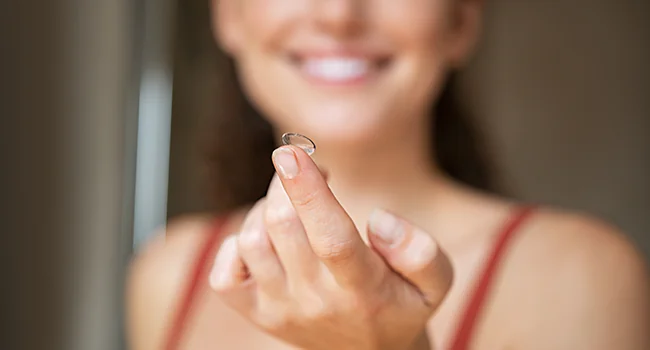
Place it on the tip of your clean index finger.
Before inserting it, inspect the lens for:
- Dust or debris
- Tears
- Cracks
- Damaged edges
- Unusual deposits
Do not use a damaged lens.
Step 3: Check Whether the Lens Is Inside Out
Look at the lens from the side.
A correctly positioned soft contact lens generally resembles a smooth bowl with the edges pointing upward.
If the edges flare outward, the lens may be inside out.
Correcting the orientation before insertion can make the process more comfortable.
Step 4: Hold Your Eyelids Open
Use the middle finger of the hand holding the lens to gently pull your lower eyelid down.
With your other hand, gently lift your upper eyelid.
Keep both eyelids securely open so that you don't blink while placing the lens.
Step 5: Look Straight Ahead
Bring the lens slowly toward your eye.
Try not to move your head toward the lens. Instead, keep your head steady and gently position the lens onto the eye.
Avoid rushing.
Step 6: Place the Lens Gently
Touch the lens gently to the surface of your eye.
Once the lens is in position, slowly release your eyelids.
Blink naturally several times.
The lens should settle into position as you blink.
Step 7: Repeat With the Other Eye
Follow the same process for your other eye.
It can be helpful to develop a habit of inserting the lens for the same eye first each time. This can reduce the possibility of mixing up lenses when the two eyes have different prescriptions.
The most important things to remember are simple: wash your hands, handle lenses gently, follow the correct wearing schedule, use the appropriate cleaning solution, avoid water exposure, and never ignore persistent eye discomfort.
Whether you are considering conventional soft lenses or a specialty option such as scleral, RGP, hybrid, or orthokeratology lenses, professional fitting is an important part of achieving comfortable and healthy lens wear.
Conclusion
Contact lenses should be fitted and prescribed by a qualified eye-care professional. The correct lens depends on your prescription, eye measurements, corneal shape, lifestyle, and eye health.